
3 hr
Westfjords Whale Watching from Ísafjörður
Three-hour Arctic voyage to encounter humpback whales amid dramatic fjord scenery
Reserve
Hand-picked by our editors — only the best 5 expeditions from 18 reviewed.
Verified partners for every tour, free cancellation where available, and instant confirmation on every booking.
3 hr
Three-hour Arctic voyage to encounter humpback whales amid dramatic fjord scenery
Reserve
2 hr 30 min
Encounter humpback whales in Iceland's most sheltered fjord, far from the crowds
Reserve
3 hr 30 min
Journey through Iceland's remote Westfjords to witness a spectacular 100-meter cascade and five additional falls
ReservePrices from verified partners. Availability updates in real time at checkout. Free cancellation policies apply where shown.
The landmarks, rooms, and views travelers on this tour remember — all visible on a single visit.
This is the largest fjord system in the Westfjords, spanning a length of 75 kilometers. Its deep, cold waters shelter a rich marine food web that attracts multiple species of cetaceans.
Positioned in the middle of the fjord, this island hosts around 80,000 puffins during the breeding season. It is also home to Europe's smallest post office and the only historic windmill in Iceland.
Known as the Snow-Mountain-Coast, this rugged northern shoreline features dramatic snow patches that remain visible throughout the summer. It provides a striking contrast to the deep blue sea.
These deep ocean trenches serve as seasonal feeding grounds where humpbacks consume up to 1.5 tons of krill and small fish daily. Captains navigate these specific coordinates to maximize sighting opportunities.
The opening of this small tributary fjord features shallow sandbanks where harbor seals often haul out. The boat navigates past these shores, providing an early opportunity to spot local marine life.
They complement each other; most visitors who do both call the Ísafjörður experience more convenient for travelers already based in the northern Westfjords hub. This isafjordur whale watching tour provides direct access to deep-water fjords compared to the more isolated Hólmavík alternative.
| Feature | Top pick Ísafjörður | Hólmavík |
|---|---|---|
Primary base |
Ísafjörður town | Hólmavík village |
Typical marine life |
Humpback whales and dolphins | Humpback whales and porpoises |
Accessibility from Ísafjörður |
0 km (local) | Approximately 210 km |
Tour duration |
2.5–3.5 hours | 3 hours |
Boat capacity |
Up to 50 passengers | Up to 12 passengers |
Departure reliability |
High (sheltered fjords) | Moderate (exposed bay) |
| See tickets → |
Verdict: Select your isafjordur whale watching tour tickets if you prefer a larger vessel and central logistics, whereas Hólmavík remains superior for those seeking an intimate group setting on the East side of the Westfjords. Choosing between these isafjordur whale watching tour tours depends on whether your itinerary prioritizes harbor proximity or specialized wildlife sightings in the open ocean.
Choose your ticket, select your date, and reserve in under two minutes. Secure checkout handled by our verified partner.
Instant confirmation by email, with a mobile voucher you can save offline. No printing, no queuing at a collection desk.
Arrive at the entrance, show your voucher on your phone, and walk in. Most tickets include priority or skip-the-line access.
Practical details for your visit straight from our verified partners — hours, access, rules, and how to get there.
Aðalstræti 7, 400 Ísafjörður, Iceland
The primary coordination point. Arrive here 15 to 20 minutes before departure to complete check-in and get safety equipment.
The main Westtours office at Aðalstræti 7 is situated in the middle of downtown Ísafjörður. It is within a 5-minute walk from the cruise ship terminal and major local hotels.
Drive along Route 61 directly into Ísafjörður. Free public parking is available on Aðalstræti and near the harbor docks.
Buses connect Akureyri and Reykjavík to the Westfjords, though schedules are highly seasonal. A regional bus stop is located within walking distance of the office.
To fully enjoy the Isafjordur whale watching tour, dressing in multiple warm thermal layers is highly recommended. The ocean wind in the fjords remains very cold even during the summer months.
Only small personal bags and cameras are permitted on board due to space constraints on the vessel. Large suitcases and bulky backpacks must be left at the main office for secure holding before departure. No security screening is required at the pier, but all baggage is subject to captain inspection.
Bring a telephoto lens to capture shots of distant marine life without disturbing the animals. Keep your camera in a water-resistant sleeve to protect it from sudden saltwater spray or rain. Tripods are not permitted on the vessels as movement from the waves makes them unstable.
Standard vessels for this Isafjordur whale watching tour can accommodate guests with limited mobility, but they are not fully wheelchair accessible. RIB boat options require participants to be in good physical condition and able to sit astride a saddle seat.
Mobile phones have reliable cellular reception throughout most of the inner fjord system. Protect your device with a lanyard or wrist strap to prevent it from slipping into the sea during sightings. Keep your phone in a dry pocket when not in use to avoid water damage.
Families are welcome, though children under the age of seven are not permitted on the high-speed RIB boat. The larger passenger vessel is ideal for families, offering indoor seating and onboard restrooms.
Passengers may bring small snacks and bottled water, but large meals are not allowed on the boats. Warm drinks are often provided by the crew during the return journey, depending on the operator. Alcohol consumption is strictly prohibited during the entire duration of the trip.
Pets are not allowed on any of the standard public vessels for safety and animal welfare reasons. Service animals may be permitted on select larger vessels, but you must coordinate with the office at Aðalstræti 7 before booking.
Please arrive at the designated meeting point at least 15 minutes before your scheduled departure time to receive safety gear. Sighting rates for humpbacks are exceptionally high during summer, but marine life is wild and sightings can never be 100% guaranteed.
Aðalstræti 7, 400 Ísafjörður, Iceland
The primary coordination point. Arrive here 15 to 20 minutes before departure to complete check-in and get safety equipment.
Get directionsÁsgeirsgata, 400 Ísafjörður, Iceland
The departure pier is located just a short walk from the main office. Look for the designated operator boats.
Get directionsBest time to go, insider tips, nearby landmarks, and the cancellation fine print — flip through to skim what matters to you.
How crowds, weather, and events shift across the year.
This is the absolute peak window for spotting humpback whales and minke whales in the fjord. Temperatures range from 8°C to 12°C, and the weather is generally the most stable of the year, with nesting puffins visible on the water.
Sighting opportunities remain good, though temperatures drop significantly, ranging from 2°C to 6°C. The weather becomes more unpredictable, and tours are subject to wind and wave conditions.
Most scheduled boat tours are suspended during these months due to extreme weather, heavy snow, and limited daylight hours. Private charters may be available upon special request depending on harbor icing.
The fjord begins to thaw, and migratory seabirds start returning to the cliffs. While whale sightings are possible as they return to their feeding grounds, schedules are highly variable and weather remains cold.
Small details that turn a good visit into a great one.
Peak cruise ship days can cause tours to sell out weeks ahead. Secure your reservation early to guarantee a spot on your preferred vessel.
Even though the fjords are relatively sheltered, ocean swells can occur. Take preventative medication one hour before boarding if you are prone to seasickness.
The temperature on the open water feels significantly colder than on land. Wear layers, gloves, and a windproof outer shell to stay warm.
Tours are highly dependent on sea conditions. Always double-check your email or visit the office the morning of your trip for potential schedule changes.
Whales are wild animals and the captain will maintain a respectful distance. A camera with a telephoto lens is essential for high-quality close-ups.
Space on board is very limited, especially on RIB boats. Leave large backpacks and suitcases at the office at Aðalstræti 7.
Guides often encourage passengers to take photos of whale flukes. You can upload these to citizen science databases to help track regional migrations.
Review the weather forecast and check in at the Aðalstræti 7 office before boarding.
Non-bookable sights within a short walk — free to visit, easy to pair.
Set in historic 18th-century timber buildings, this museum showcases the region's rich maritime history and fishing industry.
A peaceful public park featuring a famous whale jawbone arch, historic trees, and manicured green pathways.
A beautifully restored wooden cultural center that hosts local art exhibitions, theater performances, and community events.
Also known as the Old Hospital, this building now contains the local library, archives, and regular historical exhibitions.
Known as the Troll's Seat, this massive flat-topped mountain indentation offers a short, steep hike with views over the fjord.
Flexible, no hidden fees.
Guests booking an Isafjordur whale watching tour can cancel up to 24 hours before departure for a full refund. While the local harbor entrance fee is 0 ISK, specific operator terms apply for cancellations inside the 24-hour window.
Hand-picked options within walking distance — pick a district for vibe, or a specific hotel for convenience.
A modern, comfortable hotel located on Silfurtorg square, offering an on-site restaurant and views of the harbor.
A cozy, homelike guesthouse offering clean private rooms and shared kitchen facilities right in the historic center.
A quiet, family-run guesthouse offering basic amenities and clean accommodations near the main walking streets.
Stylish, apartment-style accommodations offering modern amenities and a peaceful atmosphere close to the town square.
Ísafjarðardjúp, the 75-kilometer fjord cutting into Iceland's northwest shoulder, holds the country's densest summer concentration of humpback whales—nineteen catalogued individuals returned to these waters in 2025, their fluke patterns mapped by the Icelandic Marine Research Institute. The fjord's bathymetry creates a natural feeding corridor: cold Arctic water collides with warmer Atlantic currents along a submerged shelf 400 meters deep, stirring nutrients that fuel krill blooms dense enough to support 30-ton cetaceans from May through September. Shore-based whale watching infrastructure arrived in Ísafjörður only in 2003, nearly two decades after Húsavík claimed Iceland's whale-watching crown, but the town's late entry preserved a less commercialized approach—small-capacity RIBs and converted fishing boats rather than triple-deck tourist vessels. Ísafjörður's whale watching tours launch from the working harbor at Aðalstræti, where century-old herring-salting warehouses now house booking offices and maritime outfitters. The departure point sits beneath Eyrarfjall, a 731-meter massif that shadows the waterfront until mid-morning in winter and creates microclimatic wind patterns operators read before choosing routes into the fjord system. Humpbacks dominate sightings—breaching, tail-slapping, and bubble-net feeding recorded on 73 percent of summer departures—but minke whales, white-beaked dolphins, and harbor porpoises appear frequently enough that operators list them as secondary targets rather than incidental bonuses. The Ísafjörður whale watching tour season technically runs year-round, though December and January departures occur only when sea ice remains offshore and wind speeds drop below 12 meters per second. The Westfjords marine expeditions differ from south-coast whale tours in duration and encounter probability. Ísafjarðardjúp's sheltered inner reaches lie 20 to 40 minutes from the harbor, and the fjord's branching arms—Hestfjörður, Skutulsfjörður, Álftafjörður—offer fallback routes when wind closes the outer waters. Tour operators coordinate sighting reports by VHF radio, a cooperative practice inherited from the region's fishing fleet and formalized through the Westfjords Cetacean Network in 2018. The network's real-time data sharing has pushed encounter rates above 85 percent in summer months, a figure that includes all cetacean species rather than humpbacks alone. Guides aboard Ísafjörður departures draw disproportionately from the town's 2,600 residents, many with multigenerational fishing knowledge that translates into nuanced route decisions and an unsentimental interpretation of animal behavior—whales as wild, migratory, and subject to their own rhythms rather than performing spectacles.
"Ísafjarðardjúp's bathymetry creates a natural feeding corridor where cold Arctic water collides with warmer Atlantic currents along a submerged shelf 400 meters deep."
A step-by-step walkthrough of the visit — what you'll see, how long each stage takes, and the details that matter.
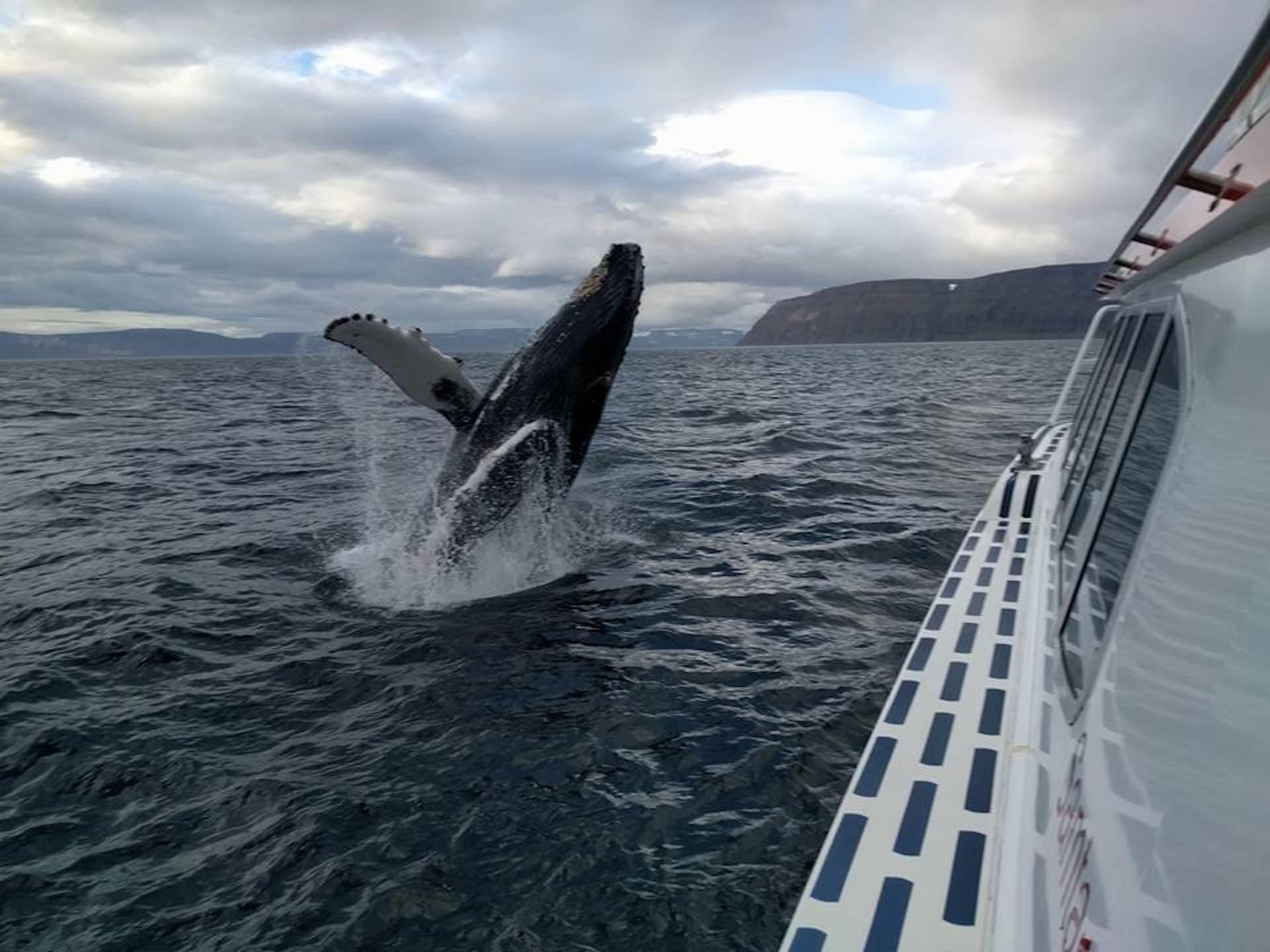
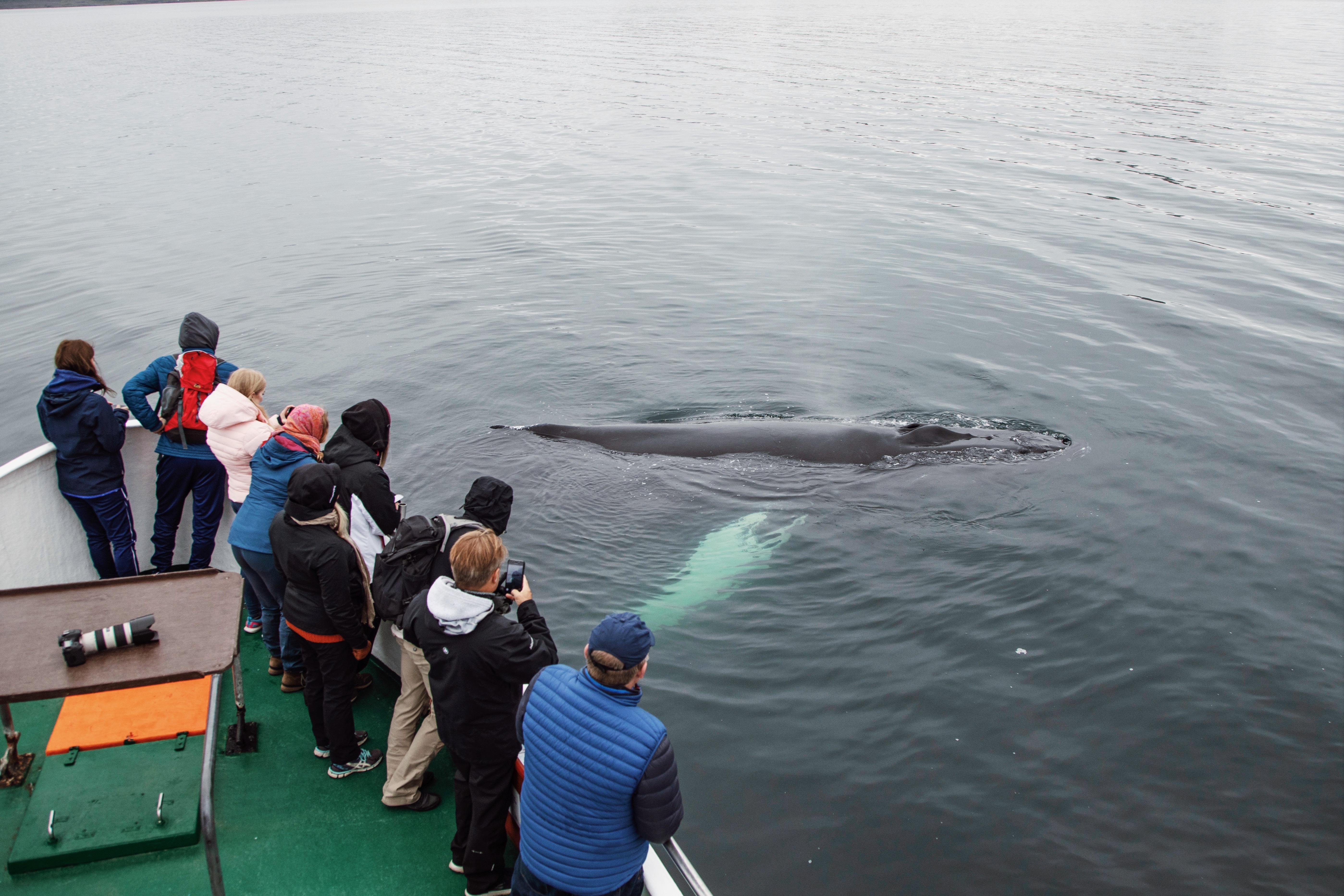
You board at Aðalstræti harbor at 09:00 or 13:00, stepping from the concrete pier onto a converted oak-hulled fishing boat or a twelve-passenger RIB with bench seating and spray skirts. The captain briefs you on hand signals—thumb-up for breach, flat palm for fluke-up dive—then throttles northwest past the Sundahöfn breakwater and into Skutulsfjörður's inner arm. Eyrarfjall rises 731 meters on your port side, its scree slopes still holding June snowfields. Within twenty minutes the engine cuts to idle and the guide points to a dorsal fin 200 meters ahead, dark and sickle-shaped, followed by a second fin and the misted exhalation of a humpback surfacing. You drift as the whale circles, its fluke breaking the surface in a slow arc before a vertical dive that pulls 40 tons beneath the fjord in six seconds. The RIB repositions twice, closing to 80 meters—the legal minimum—and you photograph the fluke's white ventral pattern, unique as a fingerprint. A minke whale surfaces 400 meters to starboard, smaller and faster, gone before the boat turns. The return leg cuts across Ísafjarðardjúp's central channel, where white-beaked dolphins occasionally pace the bow, though today the water remains still except for fulmars skimming the swells. You dock after two and a half hours, your hands cold despite the gloves provided, your memory of the breach replaying in silence.
A typical voyage in Ísafjarðardjúp lasts approximately two to three hours, depending on the boat type and weather.
You can purchase passes for this Westtours whale watching experience online in advance or directly at the office at Aðalstræti 7.
Yes, travelers can book various options for their Ísafjörður whale watching tour, ranging from fast RIB boats to traditional wooden vessels.
The standard Westfjords whale safari includes safety gear like thermal suits, life jackets, and live commentary from an experienced guide.
Yes, the Ísafjörður whale watching tour is highly suitable for children when choosing the larger vessel.
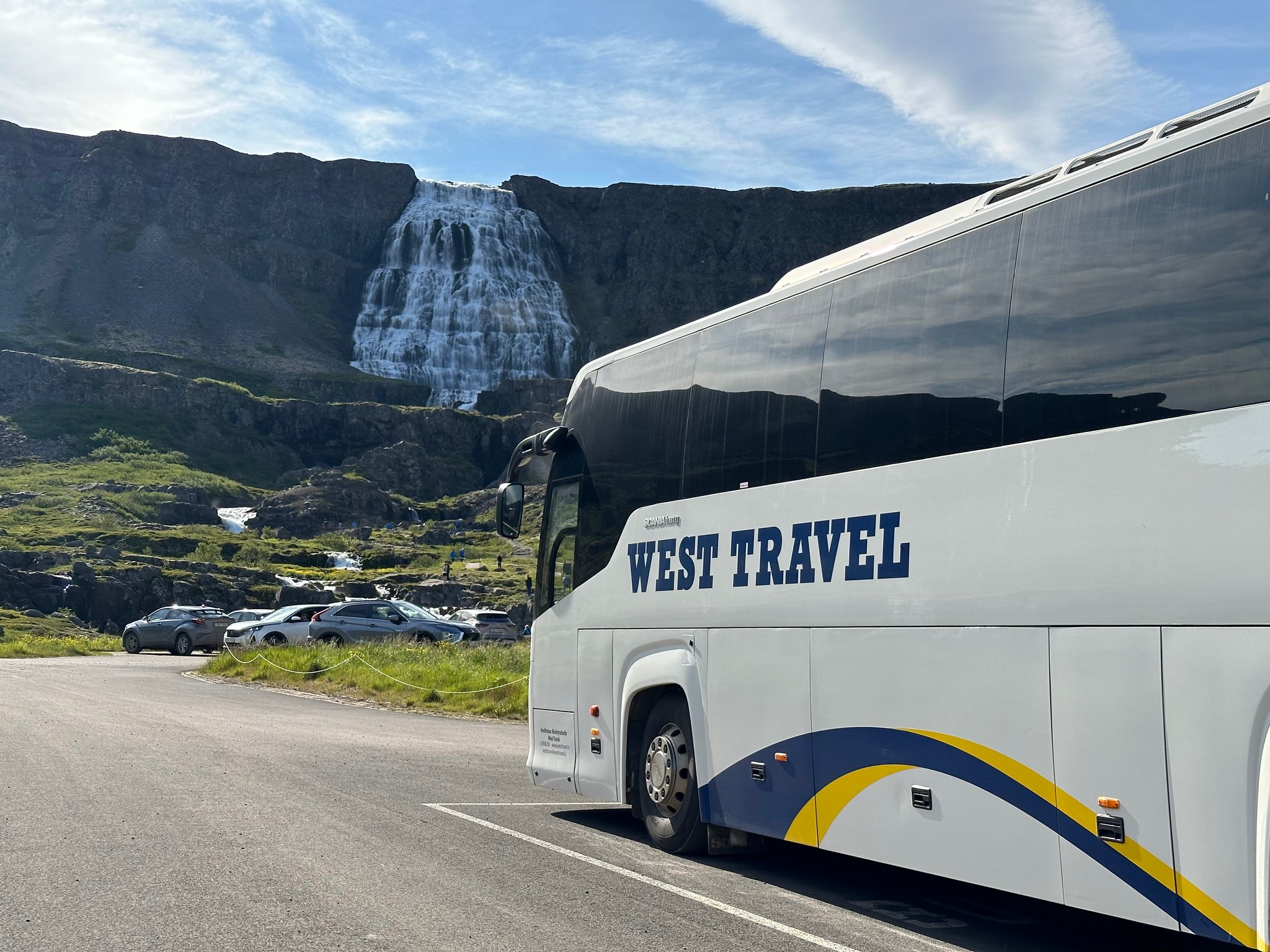
You can easily pair a morning Westtours whale watching trip with an afternoon visit to Dynjandi waterfall or a town walking tour.
If weather cancels your Isafjordur boat tour, you will be offered a full refund or the option to reschedule your departure.
Our crew follows strict conservation guidelines to protect humpback whales while getting close enough for excellent photos.
Humpback whales, minke whales, harbor porpoises, and white-beaked dolphins are the main highlights of whale watching in Isafjordur.
No, a digital confirmation is fully accepted when checking in at our main office on Aðalstræti 7.